
Intro to Figures and Configurations
From this point forth, everything you learn builds upon what you’ve already learned. These are the basics necessary to understand the concepts that allow you to accurately interpret charts.
What we call “aspects” were called “conjunctions” by the Greeks, meaning sextiles, squares, trines and oppositions were all “conjunctions.” That terminology doesn’t really help you interpret the chart accurately and it gets down-right confusing referring to the sextile conjunction, the square conjunction and so on. We use the terms “figures” and “configurations” when referring to aspects since “aspects” doesn’t do justice to what’s actually happening in the chart when the stars are forming figures.
Two stars forming a figure (an aspect) is actually uncommon in a chart. More often than not you see configurations which are three or more stars forming a figure. Let’s look at a chart:

People botch chart interpretations for any number of reasons but figures and configurations play a big role.
The non-astrologer only sees Moon opposition Sun and most non-astrologers wouldn’t even see that because they think Moon has separated from Sun.
There are no “orbs.” The sign is the orb. We ask simple questions a 5-year old can answer:
- Are Aries and Libra opposing signs? Yes.
- Is Moon in Aries? Yes.
- Is Sun in Libra? Yes.
Therefore Moon and Sun are in opposition. Period. End of story. No discussion. No debate.
Because Mars and Saturn also form figures to Moon and Sun give us an aspect configuration (or simply “configuration”) we must factor in the natures of Mars and Saturn to correctly interpret the entire configuration.
Going back to the chart above, the non-astrologer only sees Mercury opposition Jupiter and, again, most non-astrologers wouldn’t consider that to be an aspect since they are not “in orb.” There are no orbs. Mercury and Jupiter are in opposing signs and so are in opposition. Period. End of story. No discussion. No debate.
A real astrologer — a true astrologer — sees Jupiter right trine Venus right sextile Mercury opposition Jupiter which is the real configuration.
We want to reacquaint you with some of the sign meanings so you can better understand the figures and configurations that can be formed.

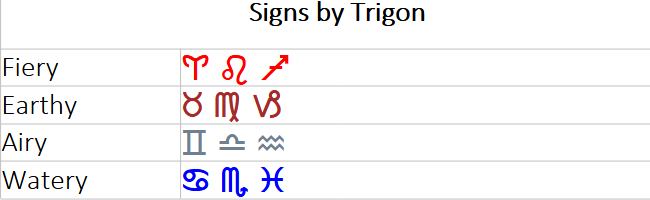
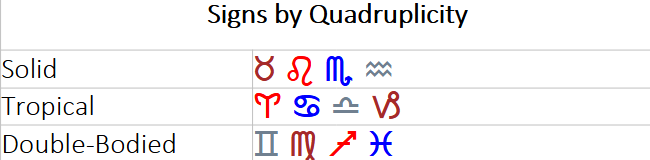
Figures and configurations come in three different flavors:
- Character Traits: That is exactly what it sounds like. The figure tells you a person has a certain character trait. Character trait aspects can sometimes manifest as one or more events in a person’s life. The type of sign (fixed, bicorporal or tropical) will give you hints as to how many times in their life.
- Condition-based: These are conditions that apply to a person. For example, two stars in a figure might indicate success. The sect of the signs tells you whether that success is short-lived (a few years) or long-term (a decade or more). The location of those two stars in the chart by house gives you hints on when their success will begin and end. The signs those stars “rule” tells you how that success comes about. These can also indicate one or more events that happen to a person over the course of their life, in this instance, they do something or someone else does something for them that results in success.
- Event-based: That is exactly what it sounds like. Two stars in a figure indicate something, let’s say Saturn right square Jupiter which may indicate failure. The type of sign will tell you how many failures (1-12 failures) and the houses those stars “rule” tells you how those failures come about and their location gives an idea when those failures will take place.
Descriptions of the figures can be found here: